Thursday, January 22, 2026

Women in Leadership: Breaking Barriers in Male-Dominated Industries


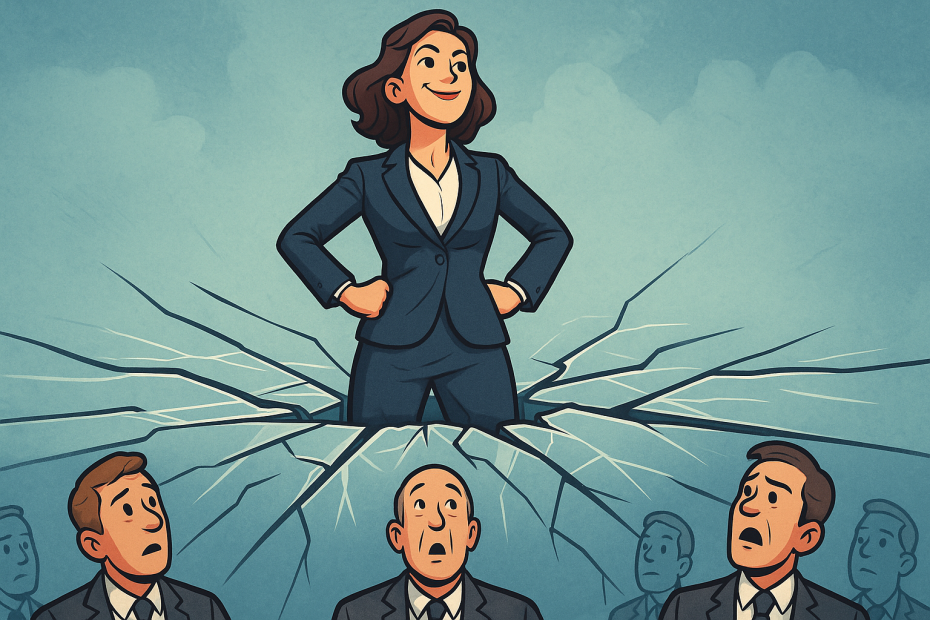
A confident woman leader standing above a cracked glass ceiling, symbolizing breaking barriers in male-dominated industries.

You already know you’re smart, capable, and have a LinkedIn profile shinier than a freshly waxed Tesla. Yet, somehow, when you walk into a boardroom, you’re treated like the intern bringing water bottles. Welcome to the circus known as “male-dominated industries.” Spoiler: there are no elephants, but plenty of clowns.

The question is simple: how do you go from being overlooked to being the one people can’t overlook? Stick around, because this guide will show you how to crash through those so-called “ceilings” like an action hero. (Think Bruce Willis in Die Hard, but with better shoes.)

Realizing the Game is Rigged

At first, you think it’s your résumé. Maybe you need another certification. Perhaps an MBA from a school with ivy climbing its walls. But nope—turns out, the “game” is less about merit and more about who’s invited to Friday golf outings. 

This might surprise you

Thursday, January 8, 2026

Health Misinformation: Debunking Common Medical Myths and Scams


A professional debunking medical myths while blocking scam advertisements with science-based health facts.

Welcome to the Circus of Health Myths

You’ve got a cousin who swears apple cider vinegar can cure everything from acne to existential dread. Your coworker insists microwaves nuke your nutrients. And don’t even get started on that random wellness guru selling “oxygen-infused Himalayan salt water.” Spoiler: none of this makes sense.

Health misinformation is everywhere. The problem? It spreads faster than you can Google “Is this legit?” So let’s roll up our sleeves and tackle the most persistent medical myths and scams—with sarcasm as our scalpel.

The Eternal “Dr. Google” Consultation

Here’s how it usually starts. You wake up with a headache, type it into Google, and suddenly you’re convinced you have three rare tropical diseases only found in South American caves. Congratulations, you’ve officially fallen into the WebMD black hole. 

Worth a closer read

Thursday, January 1, 2026

The Role of Sports in Building Character and Ethical Leadership

Congratulations, You’ve Joined the World’s Loudest Classroom

You probably started playing sports for simple reasons. Maybe you liked the competition. Maybe you enjoyed the thrill of scoring points. Maybe you just wanted an excuse to wear athletic shoes everywhere like a superhero in training.

Then someone casually mentioned that sports “build character.”

A focused athlete leading teammates during a competitive sports practice, demonstrating teamwork, discipline, and leadership development in athletics
At first this sounds like something adults say while watching you run laps. Yet over time you begin to notice something interesting. The field, court, or track slowly turns into the most intense leadership training program imaginable.

Without realizing it, you’re learning discipline, teamwork, responsibility, and emotional control—all while trying not to trip over your own shoelaces.

So how exactly does chasing a ball around turn you into an ethical leader? Let’s walk through the stages of this surprisingly entertaining transformation.

The Humbling Beginning — Where Ego Meets Reality

Your first days in sports usually begin with confidence. You assume your natural talent will carry you through every challenge.

Then practice starts.

Suddenly a coach introduces drills that make your legs question their life choices. Teammates sprint past you like Olympic rockets. You discover muscles that apparently existed only to complain.

This stage teaches the first major leadership lesson: humility.

Sports immediately show you that improvement requires effort. Talent helps, but discipline matters more.

 Showing up consistently becomes more valuable than talking about how good you plan to become.

It’s not the glamorous lesson you expected.

But it’s the one every future leader eventually learns.

The Team Reality Check

Once you survive the early training sessions, another truth appears.

You are not the entire team.

This revelation can be shocking if you previously imagined yourself as the star of a sports documentary. 

Suddenly your success depends on other people’s decisions, timing, and cooperation.

The teammate passing the ball. The defender covering a mistake. The captain organizing the strategy.

Sports quickly teach that individual brilliance rarely wins alone. Teams succeed when players communicate, trust each other, and coordinate their efforts.

You learn that leadership is less about commanding attention and more about helping everyone perform better together.

Which, incidentally, is also how successful organizations work.

The Legendary “Accountability Moment”

At some point during your sports career, something dramatic happens.

You miss an important play.

Maybe it’s a missed shot, a dropped pass, or a strategic mistake that makes the entire team stare at you like you just unplugged the internet during a global conference call.

This moment introduces accountability.

In sports, mistakes become visible immediately. There’s no hiding behind complicated explanations or mysterious spreadsheets. The scoreboard does not negotiate.

You learn to acknowledge errors, adjust strategy, and move forward.

This habit becomes invaluable in leadership roles where decisions carry consequences.

Sports train you to accept responsibility rather than search for excuses.

And yes, that lesson usually arrives right after a very uncomfortable team meeting.

The Leadership Emerges

As you gain experience, coaches start giving you more responsibility.

You organize drills. Encourage teammates. Help new players understand the system.


Congratulations—you’ve entered the leadership stage.

At first this role feels slightly awkward. Giving advice to teammates can feel like pretending you suddenly became a motivational speaker.

Yet leadership in sports grows naturally.

You encourage teammates after tough losses. You celebrate their successes. You help maintain focus when pressure rises.

Over time you realize leadership isn’t about being perfect.

 It’s about setting an example through effort, discipline, and respect for others.

And occasionally reminding teammates that arguing with referees rarely improves the situation.

The Ethics Test

Competition creates intense emotional moments.

The game gets close. Pressure builds. Everyone wants to win.

This is when ethical leadership becomes important.

You face decisions about fairness, respect, and integrity. Do you follow the rules even when nobody appears to be watching? Do you support teammates even when frustration rises?

Sports constantly present these small ethical tests.

The environment rewards players who compete hard while respecting opponents, officials, and teammates.

Over time these values become habits.

And those habits eventually shape how you behave in leadership positions outside sport


Resilience — The Superpower Nobody Advertises

Sports also introduce you to failure.

Not the small kind where you forget your homework. The dramatic kind where your entire team loses after months of preparation.

At first losing feels catastrophic. Your brain replays the game repeatedly like a dramatic movie montage.

Then something unexpected happens.

You recover.

You train again. You adjust strategy. You improve.

Sports teach resilience through repetition. Every setback becomes an opportunity to strengthen your response


Leaders who develop this mindset handle adversity with far more confidence than those who avoid challenges entirely.

The Transfer to Real Life

Eventually you step away from the playing field and enter other areas of life.

Workplaces. Businesses. Community projects.

Suddenly the lessons from sports start appearing everywhere.

Teamwork improves collaboration. Discipline improves productivity. Accountability improves decision-making.

The same habits that helped your team succeed now support your leadership abilities.

Sports may have looked like games on the surface.

Behind the scenes, they quietly built a training system for leadership development.


How Do Sports Build Character and Leadership?

  • Sports develop discipline, teamwork, and accountability through structured competition.
  • Athletes learn leadership by supporting teammates and managing pressure.
  • Ethical behavior and resilience practiced in sports transfer to professional leadership roles.

Conclusion: Character Isn’t Built in Comfort Zones

Sports rarely feel easy while you’re playing them.

They challenge your discipline, test your patience, and occasionally leave you wondering why running laps became a personality-building exercise.

Yet those experiences shape character in powerful ways.

Competition teaches humility. Teamwork strengthens cooperation. Pressure builds resilience and ethical decision-making.

Over time these lessons create leaders who understand responsibility, integrity, and the value of collective success.

So the next time someone says sports build character, remember one thing.

They’re absolutely right.

They just forgot to mention the part where it also builds sore muscles, questionable tan lines, and stories you’ll tell for the rest of your life.

Thursday, December 25, 2025

The Importance of Mentorship in Breaking Glass Ceilings


A mentor guiding a younger professional upward with cracked glass above, symbolizing mentorship in breaking glass ceilings.

You probably think you can smash the glass ceiling all by yourself, right? Just lace up your metaphorical combat boots, grab a hammer, and start swinging. Bold move. Except, spoiler alert: without mentorship, you’re just smashing your forehead against reinforced corporate glass while upper management sips lattes and pretends they can’t hear you.

Mentorship is the secret elevator that gets you past the floors you’d otherwise be stuck cleaning. Let’s walk (or stumble) through the stages of how mentorship transforms you from “that ambitious newbie” into someone who finally makes HR send out a congratulatory email about your promotion.

The “I Can Do It Alone” Phase

This is where you march into the workplace like Katniss Everdeen with a résumé instead of a bow and arrow. You assume talent, grit, and caffeine are enough. Bad news: talent is just the entry ticket, grit makes you tired, and caffeine makes you shake during presentations. 

Here’s the full story

Thursday, December 11, 2025

The Best Pickleball Shoes for Court Performance and Injury Prevention


A pickleball player sliding on court in stylish performance shoes with motion lines and court details

Oh, so now you care about shoes? Not when you sprinted across the hardwood in your 6-year-old running sneakers from that one half-marathon you never trained for—but now, after tripping over your own foot trying to return a dink shot?

Listen, you might already have the reflexes of a caffeinated squirrel and the determination of a toddler denied an iPad, but let’s face it: your shoe game is trash. And in pickleball, that’s the fast lane to rolled ankles, sore knees, and early retirement (from your recreational league, but still dramatic).

So let’s talk about pickleball shoes—yes, it’s a thing, and no, your cousin’s old tennis kicks aren’t cutting it. Let’s protect those ankles, boost your court swagger, and make sure your feet survive your midlife athletic crisis.

The “I’ll Just Wear My Gym Shoes” Phase

You show up to the court like you’re about to hit the elliptical—because duh, shoes are shoes, right? Spoiler alert: they are not. One slide into a poorly executed side shuffle and boom—your lateral stability just filed for divorce. 

Let’s break it down

Thursday, November 27, 2025

The Psychology of Decision Making: How Cognitive Biases Affect Our Choices


A person overwhelmed by confusing thought bubbles and contradictory signs symbolizing cognitive biases in decision-making

You Think You’re a Rational Genius?

Of course you do. You read labels before buying shampoo. You once said “pass” on a timeshare. You even watched a documentary on Netflix called The Brain Explained, so clearly you’re running a tight cognitive ship.

Except… your brain is probably lying to you. Constantly. Like a sneaky little gremlin in your head whispering, “Buy the name brand. It’s better. Trust me.” This article is your wake-up call, your decoder ring, your Scooby-Doo unmasking scene for the mysterious monster known as cognitive bias.

Ready to discover why you think you’re in charge—when your subconscious is actually running the show like a caffeinated toddler with a steering wheel? Let’s go.

Meet the Villains – Cognitive Biases Assemble

You’re just out here living your life—ordering coffee, picking health insurance, choosing which socks to wear—and meanwhile your brain is like, “Hey, let’s base this major life decision on what Karen said in 2008.” 

Take a closer look

Thursday, November 13, 2025

Media Bias Exposed: How to Identify Slanted News Coverage


A skeptical reader surrounded by newspapers, digital headlines, and bias indicators like red flags, megaphones, and exclamation marks.

Ah yes, you, the all-seeing, all-knowing news consumer. You scroll through headlines like a boss, skim opinion columns with the grace of a caffeinated scholar, and—if you’re feeling wild—maybe even leave a comment that isn’t written in ALL CAPS.

But now you’re stepping into murkier waters. You’ve decided to decode media bias, because apparently your morning doom-scroll isn’t stressful enough. And why not? You already survive Monday meetings and family WhatsApp groups. How hard can spotting slanted news be?

Spoiler alert: Harder than separating M&Ms by color while blindfolded. But way more fun.

The “I’m Totally Objective” Delusion

You start your journey with a noble heart and questionable confidence. You declare, “I just want the facts!” while clicking on the same news site you’ve used since 2009. It loads, the familiar layout comforts you, and—oh look—another article that totally confirms your opinion. Amazing! 

Unpack the strategy