
to cater to a more complex and diverse market. These firms are no longer just custodians of wealth; they are architects
of financial growth, adapting to the ever-changing economic environment. Their expertise spans across various
dimensions of asset management, addressing the multifaceted needs of today’s investors. From navigating global
investment opportunities to leveraging technological advancements, investment firms stand at the forefront of financial
innovation, steering their clients through the intricate world of investing.
The diversity of clientele in asset management underscores the need for investment firms to provide personalized and
inclusive financial solutions. Each client, be it an individual investor, a family office, or a large corporation, brings
unique financial goals and challenges. The importance of addressing these varied requirements lies at the heart of
modern asset management. Investment firms must exhibit an unwavering commitment to understanding and fulfilling
these distinct needs, ensuring that each client’s financial strategy is as unique as their financial fingerprint.
Addressing the varied needs of clients involves a deep understanding of their financial landscape. Investment firms
conduct thorough assessments to grasp each client’s risk tolerance, investment horizon, and specific financial
objectives. This client-centric approach enables firms to craft bespoke investment strategies that align with individual
goals, whether it's wealth preservation for retirement, capital growth for business expansion, or navigating complex
family wealth dynamics.
Tailoring Asset Management Strategies for Diverse Investors
Understanding the Unique Financial Goals of Different Client Segments
To effectively tailor asset management strategies, a nuanced understanding of the unique financial goals of different
client segments is essential. Investment firms delve into the life stages, financial aspirations, and risk appetites of their
clients. For instance, young professionals may focus on long-term growth and wealth accumulation, while retirees
might prioritize income stability and capital preservation. By recognizing these distinct goals, firms can develop
tailored strategies that resonate with each investor's journey.
Customizing Investment Portfolios to Suit Individual Investor Profiles
Customization is key in portfolio management. Investment firms take great care in constructing portfolios that reflect
the individual profiles of their clients. This process involves selecting the right mix of assets – equities, bonds, real
estate, or alternative investments – that align with the client's risk tolerance and investment goals. The art lies in
creating a portfolio that balances growth potential with risk management, tailored to the unique financial DNA of each
investor.
Techniques for Balancing Risk and Return Across Diverse Portfolios
Balancing risk and return is a delicate act, particularly in managing diverse portfolios. Investment firms employ a range
of techniques, including diversification across asset classes and geographies, regular portfolio rebalancing, and
employing hedging strategies to mitigate market volatility. Advanced analytical tools are utilized to model potential
market scenarios, ensuring that portfolios are robust enough to withstand various market conditions while still targeting
optimal returns.
5 Key Services Offered by Investment Firms to Their Diverse Clientele
In the realm of asset management, investment firms provide an array of services to cater to the diverse needs of their
clientele. Comprehensive Portfolio Management and Diversification sit at the core of these services, where firms
meticulously construct and manage investment portfolios tailored to the risk tolerance and financial goals of each
client. This involves a strategic mix of asset classes to mitigate risk and maximize returns.
Parallel to portfolio management is Personalized Financial Planning and Advisory, a service that encompasses a
broader spectrum of financial guidance. This includes understanding client aspirations and devising financial plans that
align with their life goals, whether it's wealth accumulation, debt management, or financial security.
A significant area of focus is Retirement and Estate Planning Services. These services are crucial in ensuring long-
term financial security and effective wealth transfer. Investment firms assist clients in developing retirement plans that
ensure a stable income flow in later years and estate planning strategies that address inheritance, tax implications, and
legacy preservation.
Tax Optimization Strategies form another crucial aspect of asset management. Investment firms help clients navigate
the complexities of taxation, employing strategies that minimize tax liabilities while complying with legal standards.
This involves understanding the nuances of tax laws and applying them effectively to benefit clients' financial positions.
Lastly, Access to Alternative Investments and Global Markets offers clients opportunities to diversify beyond
traditional investments. Firms provide pathways into private equity, hedge funds, real estate investments, and emerging
global markets, catering to clients seeking higher returns and exposure to diverse economic environments.
Adapting Asset Management to Changing Demographics and Investor Needs
The landscape of asset management is continually evolving, especially with the shifting demographics and emerging
needs of investors. The Evolving Expectations of Millennial and Gen Z Investors have brought new dynamics into the
financial sector. These younger investors are not just tech-savvy; they also demand transparency, social responsibility,
and digital convenience in their investment choices.
Integrating Technology and Digital Tools in Client Management has become indispensable in meeting these new
expectations. Investment firms are increasingly adopting digital platforms for portfolio management, client
communication, and transaction processing. The digital transformation in asset management is not just about efficiency;
it's about reshaping the client experience to meet the expectations of a tech-oriented generation.
Furthermore, there’s a noticeable Shift Towards Sustainable and Impact Investing. A growing segment of investors,
particularly among younger demographics, is showing a strong preference for investments that are not only financially
rewarding but also socially and environmentally responsible. Investment firms are responding by integrating
ESG (Environmental, Social, and Governance) criteria into their investment processes, reflecting a broader shift
towards value-driven investment strategies.
These services and adaptations underscore the commitment of investment firms to cater to the evolving needs and
preferences of their clients. By embracing change and prioritizing client-centric approaches, these firms are not only
growing their own businesses but also empowering their clients to achieve their diverse financial goals in a rapidly
changing world.
Navigating the Financial Terrain: How Investment Firms Tailor Services
to Client Needs
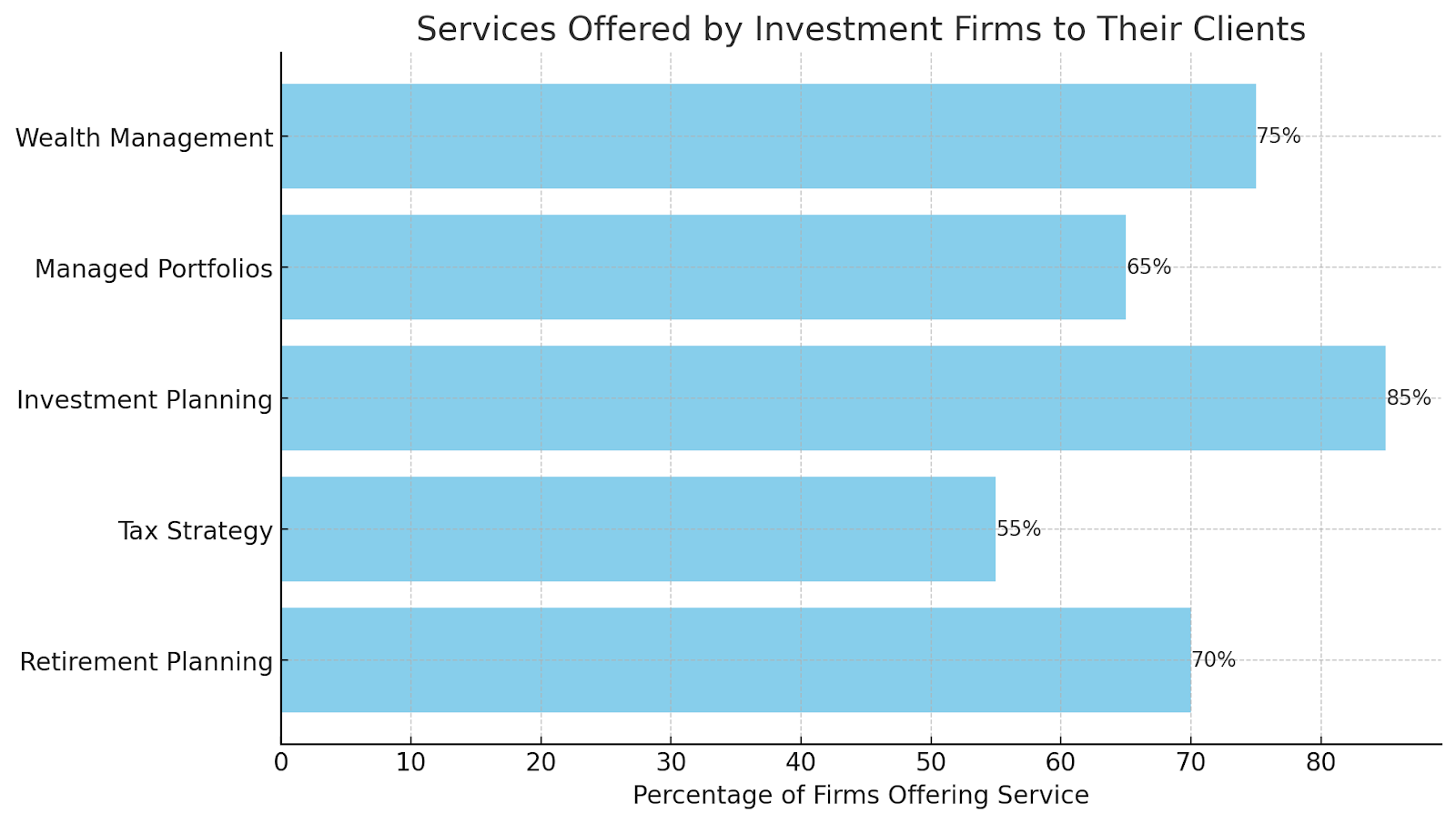
In an ever-evolving financial landscape, investment firms stand as beacons of guidance and growth. Catering to a
diverse clientele with unique financial goals, these firms have expanded their service offerings well beyond traditional
boundaries. Our analysis, backed by data from Charles Schwab, a leader in the industry, reveals a comprehensive array
of services tailored to meet the varying needs of investors.
From wealth management strategies that adapt to changing life circumstances, to managed portfolios aimed at specific
investment goals, firms are not just managing assets—they're cultivating financial well-being. Investment planning
goes hand-in-hand with tax strategies, ensuring that every financial move is optimized for both growth and efficiency.
The pinnacle of this service spectrum is retirement planning, a critical component in securing long-term financial stability.
This graph vividly illustrates the emphasis placed on these services by investment firms. The data underscores a
significant trend: while wealth management and investment planning lead in prevalence, other services like tax strategy
and retirement planning are equally integral to the firms' offerings.
Investment firms are much more than asset managers; they are partners in the financial journey, offering a range of
services to navigate the complex terrain of investments. This commitment to diversified and personalized services is
not just a response to market demand—it's a reflection of the evolving narrative in asset management, where every
client's financial story is unique and every strategy is meticulously crafted to fit their individual goals.
FAQs
How Do Investment Firms Stay Ahead in a Competitive Market?
In the ever-competitive landscape of asset management, investment firms stay ahead by continuously innovating
their service offerings, embracing cutting-edge technologies, and maintaining a deep understanding of market
trends. They differentiate themselves through specialized expertise, exceptional client service, and by crafting
unique investment solutions that resonate with evolving investor needs and market dynamics.
What Are the Challenges in Managing Assets for a Heterogeneous Client Base?
Managing assets for a diverse client base presents several challenges, including the need to understand and meet
varied investment objectives, risk appetites, and financial backgrounds. Investment firms must balance these
differing needs with market opportunities and regulatory constraints, ensuring personalized yet compliant service.
How Important is Technological Innovation in Modern Asset Management?
Technological innovation is pivotal in modern asset management. It enhances analytical capabilities, improves
client interaction through digital platforms, and facilitates more efficient management of assets. In an era where
speed, accuracy, and accessibility are key, technology is a crucial enabler in delivering top-tier asset management
services.
What Is the Impact of Global Economic Trends on Asset Management Strategies?
Global economic trends significantly influence asset management strategies. Factors like geopolitical shifts,
regulatory changes, and global market movements require investment firms to be agile in adjusting strategies.
Firms must continuously monitor these trends to mitigate risks and capitalize on emerging opportunities for their
clients.
In conclusion
As we reflect on the dynamic role of investment firms in modern asset management, the critical importance of
personalization and adaptability in client service stands out. These firms, through their commitment to understanding
each client's unique financial journey and adapting to an ever-evolving financial landscape, are pivotal in navigating
the complexities of today's investment world. Looking ahead, we see an ongoing evolution of investment strategies,
shaped by technological advancements, global economic trends, and the diverse needs of investors. Investment firms
that excel in these areas will continue to play an integral role in shaping the financial futures of their diverse clientele.


